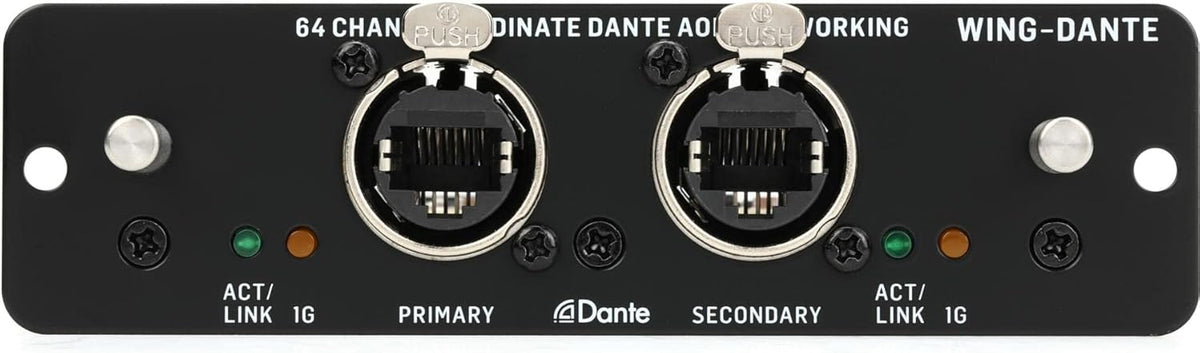
Behringer WING-DANTE Dante Expansion Card — 64×64-Channel Audinate AoIP for WING Consoles Kenya
Behringer WING-DANTE Dante Expansion Card — 64×64-Channel Audinate AoIP for WING Consoles Kenya
Couldn't load pickup availability
 Need help before checkout?
Chat with Zamar on WhatsApp
Get product advice or a quote before you order.
Need help before checkout?
Chat with Zamar on WhatsApp
Get product advice or a quote before you order.
The Behringer WING-DANTE Dante expansion card is the upgrade your WING console needs to operate inside a fully networked audio environment. Slot it in, connect to your Dante network, and you have 64 inputs and 64 outputs of low-latency audio over standard Ethernet. No proprietary cabling. No signal degradation. Just clean, reliable AoIP at 48kHz.
Built around the Audinate Brooklyn II module, the Behringer WING-DANTE Dante expansion card delivers the same industry-standard Dante performance found in professional broadcast, live sound, and studio installations worldwide. Dante Controller runs on Windows and Mac, giving you full routing control and device management from any machine on the network. Discovery is automatic. Routing is drag-and-drop. Setup is fast.
The card ships with both Primary and Secondary RJ45 network ports. That redundancy matters in mission-critical environments where a single cable failure cannot be an option. Whether you are running a live concert, a broadcast truck, a house of worship, or a distributed audio installation, the dual-port design keeps your signal path intact even if one network path goes down.
Compatibility is exclusive to the Behringer WING console. The card drops into the WING expansion slot and integrates directly with the console's routing matrix. Once installed, the WING sees all 64 Dante channels as native I/O, available for assignment to any bus, mix, or recording path. Pair it with Dante-enabled stage boxes, amplifiers, DSPs, or recording interfaces and you have a fully scalable, networkable audio system built around one of the most capable digital consoles in its class.
The Behringer WING-DANTE Dante expansion card is available in Kenya through Zamar Audio Solutions with delivery to Nairobi and nationwide. If you are building or expanding a Dante-based infrastructure around the WING platform, this is the card that makes it happen.
Note: Latency figures are configurable within Dante Controller and will vary depending on network topology and buffer settings. Verify your specific latency requirements against your network infrastructure before deployment.